Integrated SEO Guide: How to Increase Traffic & Leads
Web Studio Content

It is a software program designed to aid web admins in writing high-quality web content. It contains a learning curve that can draw web admins off, but the course comes in. It takes a writer through every aspect of the tool, indicating how one can harness the power to create great content. An individual will get an opportunity to learn from the leading expert on Web Content Studio, who is a respected SEO and content creation specialist. Through the course, one learns how to unleash the complete control of Web Content Studio to write content that they are proud of and content that the search engines will love. Andy Williams is the creator of the web studio content program he utilizes to create his articles. He is a trustable source because he has been in the (Search Engine Optimization) SEO business for over two decades. He also runs a website known as ezSEONews, where he teaches his visitors and newsletter subscribers various skills required for running a successful website. The primary goal of developing such software is to aid him in creating quality-ranked articles. More here...
Web Studio Content Summary
Contents: Software
Creator: Andy Williams
Official Website: webcontentstudio.com
Price: $167.00
My Web Studio Content Review

The interface is user friendly with its intuitive layout. Also, the addition of the prompt, with expert advice sets it apart from all the other similar programs. The Web Studio Content installation process is clean and without any unpleasant surprises like hidden toolbars, adds or anything like that. However, the installation process takes a bit longer than expected and you actually have to go through ten steps before the installation is complete, but that can hardly be considered a downside though.
I personally recommend to buy this software. The quality is excellent and for this low price and 100% Money back guarantee, you have nothing to lose.

Google Sniper

More Information
This system of money-making online has what NO other online money making system has: solid Proof that it works. Google Sniper has screenshots and bank statements to Prove to you that their system of making money works. And HOW does that work, do you ask? Google Sniper is an advanced marketing tool that helps you set up websites and start making money from them right away, by using Google algorithms to target customers that want to buy what you are selling! People have made upwards of $12,000 per Month on Google Sniper Some sites are cranking out as much as $400 per day. Google Sniper is a complete online marketing machine that is impervious to changes in the Google Algorithm because it works Inside the algorithms. This is the only system that you will find online that makes the money it promises AND has proof to back it up! More here...
Google Sniper Summary
Contents: Premium Membership
Creator: George Brown
Official Website: gsniper.com
Price: $47.00

Changing the Search Engine
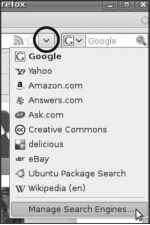
I use Google for my search engine, but I rarely use it for searching book titles. Instead, I prefer to use Amazon.com. But instead of having to visit http www.amazon.com to search for a book I'm interested in, I can click the downward-pointing arrow indicated in Figure 9-17 and select Amazon.com from the list. I type in my book title or keywords, and my search results will be pulled from Amazon.com's database of books, not the entire Internet that Google would provide. Final results are displayed using whatever search site is selected. Figure 9-18 shows that I'm directed straight to Amazon.com's web site the search term I entered (Ubuntu) is passed along, and a presorted list of possible books is provided. If you do this, don't forget to change the search engine back
Search Engines
Search engine is a name that applies to a group of hardware and software tools that help you search for World Wide Web sites that contain specific information. A search engine relies on a database of information collected by a Web crawler, a program that regularly looks through the millions of pages that make up the World Wide Web. A search engine must also have a way of collating the information the Web crawler collects so that you can access it quickly, easily, and in a manner that makes it most useful to you. This part of the search engine, called an index, allows you to search for a word, a group of words, or a concept it returns the URLs of Web pages that pertain to what you are searching for. Many different types of search engines are available on the Internet, each with its own set of strengths and weaknesses.
The Firefox Web Browser
To the right of the URL box is a search box where you can use different search engines for searching the Web, selected sites, or particular items. A pop-up menu lets you select a search engine. Currently included are Google, Yahoo, Amazon, and eBay, along with Dictionary.com for looking up word definitions. Firefox also features button links and tabbed pages. You can drag the URL from the URL box to the button link bar to create a button with which to quickly access the site. Use this for frequently accessed sites.



A21 Web Sites Devoted to GNULinux A211 MUO
And, of course, remember about your favorite search engines. Generally speaking, it is the most practical information seeking tool. A few carefully chosen keywords in a search engine will often produce the needed answers to your specific problem. In Google, you can even make a GNU Linux-oriented search by typing http www.google.com linux (http wOT.google.com linux ).
News Proxy and Search Servers
Dig, known officially as ht Dig, is a Web indexing and search system designed for small networks or intranets. Dig is not considered a replacement for full-scale Internet search systems, such as Lycos, Infoseek, or Alta Vista. Unlike Web server-based search engines, Dig can span several Web servers at a site. Dig was developed at San Diego State University and is distributed free under the GNU Public License. You can obtain information and documentation at www.htdig.org , and you can download software packages-including RPM packages-from ftp.htdig.org .
Getting Support for SUSE and openSUSE
The openSUSE.org Wiki (http en.opensuse.org ) is the place to search for answers about openSUSE. To try the free search engine at the site, just enter your term in the Search box. Check the news and events box for the latest news about openSUSE. For a more interactive experience, select the Communicate link to gain access to mailing lists, online forums, IRC chats, and other tools for connecting you to the openSUSE community You can also follow links to PlanetSUSE (http planetsuse.org), where you can read blogs from members of the openSUSE community If you are really stuck, try the openSUSE Support Database (http opensuse.org SDB SDB ).
Web Services Enumeration and Manipulation
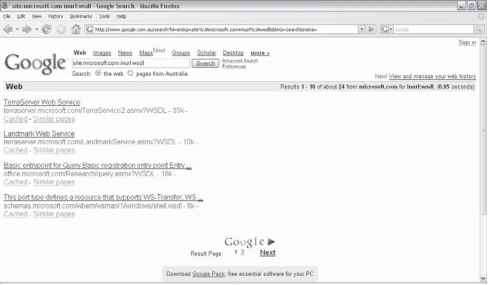
The simplest way of finding this file for an organization, if you are lucky, is by using the advanced options in a search engine. In Google you can use either of the following search terms. An example is shown in Figure 13-7. This requires that the organization has either made the WSDL file available for a public web service or accidentally leaked the file onto the Internet due to weak ACLs, where search engines and attackers can find it. You could also find this file by crawling an organization's web application to determine whether a link exists to the WSDL file, as well as by brute-forcing common WSDL-related filenames and directories, or by appending the 7wsdl parameter to the end of each web application program. Figure 13-8 Example WSDL file for a Name Search web service Figure 13-9 post data for a request to the Name Search web service
S3 Make Ubuntu safe for children to use


On the other hand, if there's a site that Dansguardian lets through that perhaps it shouldn't, then you can add it in exactly the same way to the file etc dansguardian bannedurllist. You might choose to add various search engines to this list if you wish to stop children being able to seek-out objectionable material. For example, to stop Google being used, you could add google.com to the list. Bear in mind that you'll also need to
Building a Standalone Package
To do is to use a search engine such as Clusty or Google to try to locate someone who has already built the application that you're looking for and offers it as a DEB package that you can install on your Linux system. Some trust issues are involved in this scenario you have to hope that the person who built the package did it correctly, and also that they didn't hack the software in some evil way. The former is usually the case, and the latter has never happened to me, but you never know. So, it's far safer to simply build and install the package yourself. As they say in my favorite computer-related movie, the key to building software is to Use the source, Luke . Your favorite search engine should make it easy to locate the search with a query like package-name source download. In my case, the Clusty search engine identified that I could find the source code for XMMS at www.xmms.org , from the URL http xmms.org files 1.2.x xmms- 1.2.11.tar.gz.
Using the Konqueror Browser
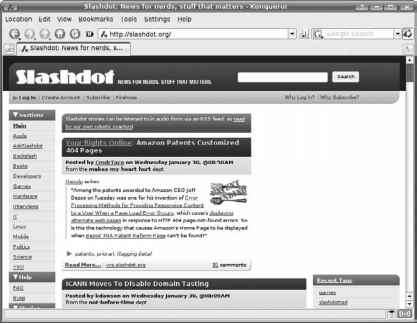
One of my favorite Konqueror features of all time is its support for Web shortcuts. These are special strings that enable you to go directly to a portion of a site without explicitly typing an entire address. For example, to search for something using the Google search engine, you can simply type gg followed by what you want to search for in the location bar to go directly to the search results for those terms. Some other great shortcuts are vi word(s) Does a search for the specified word(s) using Vivisimo's Clusty search engine and Web site at http vivisimo.com .
Flex Builder For Linux Kernel
After installation, the IDE is accessible via Tools Selenium IDE in the Firefox menu. To illustrate the IDE functionality, let's re-create the above Google search test case using the IDE. In order to do this, you simply should run the IDE, check that the record button is on, open the http www.google.com page, type selenium and click Google Search. As you type, the Selenium IDE captures what you do (Figure 3).
Searching Files with grep
When using or administering a system, you often need to look for lines in a file that contain a certain string. In the first example that follows, you simply find the lines in the file that contain the string bible. The examples with tail are examples of piping the output from one command to another a very powerful concept that was also introduced in the section Advanced Shell Features, earlier in this chapter. In the first case, you get the output from the tail command, and you just select the lines that contain 404. In the second, you select the lines that do not include the string googlebot the -v option indicates not. In the last example, the * symbol represents the start of a line, so you see only the lines that do not start with the tail -100 var log apache access.log grep -vgooglebot Looks in the last 100 lines of the web server log for lines that don't indicate accesses by the Google search robot



Reading Documentation with Konqueror
But Konqueror doesn't stop here when it comes to getting information. Want to use a search engine on the Internet To find pages about Tux (the Linux mascot) on, let's say, the AltaVista search engine, simply type the following in a mini command-line or the Konqueror URL entry line and a Konqueror window with (at the time of this writing) 1,319,135 search results pops up. This works with many other search engines as well. See Table 11-1 for some of the most popular search engines together with their prefixes. Table 11-1. Popular search engines and their prefixes Search Engine AltaVista If your favorite search engine is not configured (which is quite unlikely, actually), you can configure it yourself by opening a Konqueror window and selecting Settings, Configure Konqueror, and then Enhanced Browsing. The Enable Web Shortcuts section on that configuration page contains all the preconfigured search engines and even lets you add your own.
Using the Kthememanager Application to Install Themes
The previous section explained how to use the System Settings application's Appearance screens to customize the appearance of the theme that is currently being used on your Kubuntu system. However, many complete alternative themes are available on the Net that enable you to completely replace the theme that is currently being used on your system. My favorites KDE theme sites are KDE-Look.org (www.kde-look.org ), the KDE section of SkinBase.org (www.skinbase.org kde.php ), and Freshmeat's KDE themes section (http themes.freshmeat .net browse 57 ). A quick Web search for KDE themes with your favorite search engine will turn up many more sites. Themes for different KDE versions are very different make sure that you select the version that is designed for use with the version of KDE that is present on your system. The 3.x themes should work fine on a default Kubuntu system.
Jwhois Looks Up Information About an Internet Site
The jwhois utility replaces whois and queries a whois server for information about an Internet site. This utility returns site contact and InterNIC or other registry information that can help you track down the person who is responsible for a site Perhaps that person is sending you or your company spam (page 1056 ). Many sites on the Internet are easier to use and faster than jwhois . Use a browser and search engine to search on whois or go to www.networksolutions.com whois or www.ripe.net perl whois to get started.
Configuring a Gnome Online Desktop
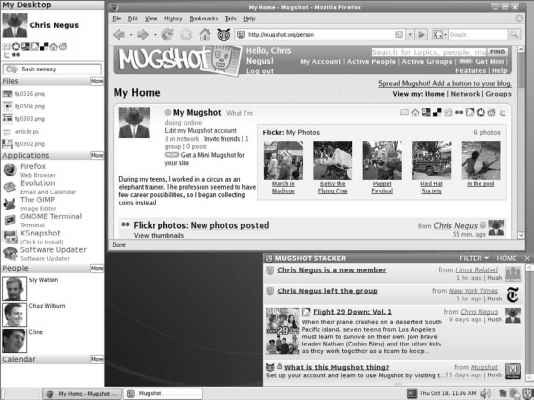
Small icons beneath your user name represent the configured online services. A search box lets you select from a half dozen different search engines. Popular applications and files you have opened recently appear on the sidebar. You can also see your Google calendar and the people you have invited to be your friends.
NDIS Wrapper Tips and Tricks
For me, one of the most frustrating sets of experiences has been with a variety of LinkSys WPC54G wireless PCMCIA cards, all of which I've gotten working, but only after significant driver gymnastics, head scratching, Google searches, and commiseration with fellow Linux devotees. (I was originally planning to title this section The LinkSys WPC54G, or How I Spent My Summer Vacation, but I am trying to generalize what I've learned rather than simply provide a single set of instructions.) By the way, these are great cards that support 802.11g (and therefore 802.11b), and because I typically find LinkSys hardware to be inexpensive and reliable, I often recommend them to friends. Unfortunately, a HUGE problem with these cards is that LinkSys has used a variety of wireless chips in them over the years, so they often use different drivers, each of which seems to require its own tweaks to get it to work with the ndiswrapper module.
The Linux Source Tree
Kernei-parameters.txt This file is a list of most of the arguments that you can pass at boot time to configure kernel or hardware settings, but it does not appear too useful at first glance because it is just a list. However, knowing that a parameter exists and might relate to something you are looking for can assist you in tracking down more information because now you have terms to enter into an Internet search engine such as http www.google.com linux .
Playing Digital Media and Obeying the Law
Although DCMA has provided some clout for content providers to legitimately protect their material, such as persuading search engines to drop information about links to illegally posted and copyrighted information, there are times when that clout has been abused. Some copyright holders, it seems, are more than willing to use the DMCA to curtail three rights allowed under pre-DMCA copyright law. Copyright law stipulates the following
Internet passes the 100 Million Mark
Database numbers, for some reason, are hard to come by, with most of the industry trusting Gartner Group to do the measurement. This is a proprietary report, for which Gartner charges, so will use a different approach. The most popular databases, as measured by the number of Google searches, and reported by Citrus Technology, are
Simple Steps To Installing And Configuring A Website Using Word Press And Ubuntu
We just need to create a name for the site, an admin user and password and define if we want the site to be index from google. If this site is host on your home network and is not exposed to the internet with a port forward, google and other search engines will not see your site so they can't index it.
Joomla 1.5, 1.7, 2.5: Customizing search results
Joomla includes component view overrides in templates. This is the ideal technique for restyling and rearranging your search results in Joomla. If you are not familiar with the output overrides, they are explained well in an old post on the Joomla Documentation site. That post discusses Joomla 1.5 explicitly, but the template overrides have changed very little (if at all) between 1.5 and 2.5.
Controlling Web Robots
Your Web site isn't always accessed by human users. Many search engines index your Web site by using Web robots programs that traverse Web sites for indexing purposes. These robots often index information they shouldn't and sometimes don't index what they should. The following section examines ways to control (most) robot access to your Web site. Frequently used search engines such as Yahoo , AltaVista, Excite, and Infoseek use automated robot or spider programs that search Web sites and index their contents. This is usually desirable, but on occasion, you may find yourself wanting to stop these robots from accessing a certain part of your Web site. If content in a section of your Web site frequently expires (daily, for example), you don't want the search robots to index it. When a user at the search-engine site clicks a link to the old content and finds that the link doesn't exist, she isn't happy. That user may then go to the next link without returning to your site.
Vendor Web Sites and Other Resources
Search engines http www.google.com http www.altavista.com http www.northernlight.com http www.yahoo.com Of course, it's impossible to create a static list of resources that will fulfill your ever-changing needs. If standard and familiar sources don't offer what you're looking for, don't hesitate to use a search engine. A targeted search on a quality search site can be surprisingly fruitful.



Spam filtering with qpsmtpd
By default the file installed will be pretty minimally configured - with most of the checks disabled. To start adding new tests to your server you will need to adjust the plugins file. As an example you can drop clients which start sending traffic to your server without waiting for the prompt to be sent, this can be done by enabling the earlytalker plugin
Writing a simple indexer and searcher with Lucy::Simple
There are several well-known crawlers, indexers, and search interface solutions out there. Previously this site used mnogosearch, which was introduced and documented in the brief article setting up a search engine for your website. Looking around there were several promising packages which would let me index a series of documents articles, but with my preference for Perl code I was immediately drawn to Lucy Simple which is a stripped-down interface for the Apache Lucy search engine library.
Interception of files with tcpdump
If you're familiar with the programs mentioned then you can probably stop reading now, as the last sentence just gave you all the information you need. Anyone who isn't familiar with these programs, I urge you to look at the man pages (or search Google) for the three utilities previously mentioned.
Question: Preventing Apache referer spam?
Referer spam is simply described as incoming requests to your webserver with a website being listed in the referer field. The intention of submitting requests is that these logs will be archived somewhere and that search engines will spider these logs and increase the score of the spammed websites.
Newsgroups Where People Talk About christianity
The Norwegian University of Science and Technology, located at Trondheim, has an FTP search engine on the web, located at http ftpsearch.ntnu.no ftpsearch , that can find files on anonymous FTP servers world wide. Other files search engine are located at http www.filez.com and which can find files for specific platforms (e.g. unix, windows, mac) or specific formats (e.g. wav, midi, fonts, source code).
Writing Java Servlets
A Web search engine such as Google (www.google.com ) is a good example of an interactive Web page the user enters one or more keywords, and the Google search engine returns an HTML document containing links to other Web pages that contain the search words. The HTML document returned by the search engine is dynamic because the contents of that page depend on what search words the user types it's not a predefined, static document.
8 reasons to use Ubuntu
This indicator is not objective, because not all users of a distribution visit Distrowatch or Losst. And others visited several times. Therefore, statistics can be very distorted. A more interesting measure is the number of queries about a particular distribution in the search engines, for example, in Yandex. According to statistics Yandex, Russian users ask most about Ubuntu. In second place is Debian, and Linux Mint only on the third. The Google Trends about it all a little different, but in General Ubuntu is also in the first place.
Shawn Powers
Reuven Lerner gives us all a lesson in jQuery. It's growing in popularity, and Reuven shows us some reasons why. It certainly doesn't mean you have to switch if you're already using something like Prototype, but it's definitely something you'll want to read about. Although, perhaps something like the Google Web Toolkit is more appealing. There's no doubt Google knows its stuff when it comes to Web development, and using the GWT, you can harness much of Google's power from within your Java programs. Federico Kereki walks us through developing Web 2.0 applications using Google's Web toolkit, again emphasizing the idea of the Web as a platform rather than just a device
Djbdns
Nevertheless, DNS is crucial to the Internet. It is one of those services that always should just work , and it's only when it doesn't work that people notice (and complain, loudly). Readers may remember the great Google vanishing act in May 2005, when the search engine giant briefly disappeared from the Internet. Many quickly assumed the site had been hacked, but the problem turned out to be a DNS configuration issue. The mishap was fixed quickly, but it highlighted how even the mightiest of the mighty can be crippled easily by a simple misconfiguration.
Using a Scanner
Most modern scanners are USB devices and are well supported on Linux systems, as are older scanners that use a real SCSI interface. Scanners are supported on Linux systems through the SANE (Scanner Access Now Easy) interface and associated front-end and back-end applications. The home of the SANE project is www.sane-project.org . If you are still shopping for a scanner or are interested whether support for a specific scanner is available under Linux, see the page at www.sane-project.org sane-supported-devices.html, which also provides access to an easy-to-use search engine application that provides data about specific scanners.
Web Feed Hacking
So, are you scared of web feeds yet No Well here is another interesting point. You can be subscribed to a web feed automatically by your reader without even knowing it. Google Desktop, by default, has an option enabled that says Automatically add clips from frequently viewed sites. This means that as you are surfing the Internet checking out crazy websites that have turned up in your Google searches a couple of times, you may automatically be subscribed to RSS feeds from untrusted websites that contain malicious content.
Novell Quick Finder
Although QuickFinder isn't a required web service for OES Linux, it is all about making your web resources available to employees and customers as quickly and accurately as possible. Supporting everything from simple internal search solutions to complex search services that you can offer to organizations for a fee, QuickFinder is one of the fastest and most accurate search engines currently available. Novell QuickFinder, previously called Novell Web Search, offers a powerful, full-text search engine that you can use to add search capabilities to your Internet or intranet websites. These capabilities can be integrated into your Apache Web Server environment through custom search forms and search result pages. These pages can be created from scratch or based on one of the included page templates.
Web Development
Web development isn't just for Spiderman anymore. Next month, we look at ways to improve the already venerable Ruby on Rails. That's not where we stop though we have Django, Pylons and TurboGears for Python as well. If you still want more, the Google Web Toolkit might tickle your fancy, or one of a bunch of other Web development articles is bound to get your spidey sense tingling. Whether you're a new Web programmer or an old hand, you won't want to miss next month.
Finding Torrents
Luckily, many sites provide search engines that are specifically designed for finding torrents. Some of my favorites are the following When getting started, you may also want to visit http netforbeginners.about.com od peersharing a torrent_search.htm, which provides a user-submitted list of popular BitTorernt search engines.