Best Home Organization Books
Easy Organizer
The easy organizer is not only a planner; it much more than planning. It helps solve problems of draining the brain; it comprises tons of forms, logs, checklist, and information sheets that will help you organize and store essential information concerning each aspect of your life in an incredibly convenient place. This tool was created by Maria Gracia, who worked as an organizing and management specialist in New York City. You will have an easy to use the home for every thought, scattered lists, and notes of essential information in your life. You will now be able to tell where all of the information is found; no more searching. The Easy Organizer is divided into various sections like family and friends, goals and planning, personal growth and reflection, home, garden and Auto, home inventory, food and shopping, cleaning and chores, health, exercise, and medical. The Easy Organizer is an enormous resource that will offer you peace of mind knowing that all your essential information is at the fingertips. The Easy Organizer can change your life a more significant part. It may make you save a lot of time when doing various things. You will never regret coming along with The Easy Organizer ebook, for it will solve so many problems in your life. It is swift and straightforward to get yourself an Easy Organizer ebook. Read more...
Contents: Ebook
Author: Maria Gracia
Official Website: www.getorganizednow.com
Price: $31.95
Easy Organizer

The author presents a well detailed summery of the major headings. As a professional in this field, I must say that the points shared in this book are precise.
This ebook does what it says, and you can read all the claims at his official website. I highly recommend getting this book.
Read full review...
Declutter Fast
Declutter Fast How to Get Your Home in Order Almost Immediately is a systematic and a well-planned approach that helps individuals declutter their entire living space or offices instantly. Within the program, individuals learn the strategies they can use to avoid procrastination with just five minutes. It is a product of Mimi Tanner who encourages individuals to make a distinction between the cloths and the shoes that they wear from the items they need to dispose of. The program helps individuals put their houses in order by following just simple steps. It is a 71-page book and will help you make drastic changes in your house, allowing you to pay attention to what is more urgent and significant. It is a legitimate program and will help you put your home in order over a short period of time. Tens of thousands of individual of individuals have benefited from the program. You too can benefit immensely. Read more...
The Declutter Fast System Summary
Contents: Ebook
Author: Mimi Tanner
Official Website: www.declutterfast.com
Price: $34.97
Cleaning Up Packages with APT
After your initial installation of an Ubuntu release, Ubuntu keeps downloaded packages cached in var cache apt to speed up downloading if you ever need them again. This can eventually use up a lot of disk space. You can remove this package cache, but you will need to download a removed package again at a later date if it is needed for dependencies. Clean up the cache by giving apt-get the clean option. We show how this works by first running the Linux find command on the var cache apt directory to show the packages currently cached Now clean up all the packages cached in the APT cache directory, and then verify that they are removed by running the find command again
Place Icons on Your Desktop
While icons can be extremely helpful, adding too many icons to your desktop can create quite a bit of clutter. It is good practice to clean up your desktop every so often and to delete any unused icons. to a window that controls the specific icon. Try this with the Chess icon you just created. On the Chess Properties window, select Emblems. You should now see an assortment of orange emblems that can be attached to your icon. Choose one, such as the Star, by putting a check in the box and then click Close. You should notice that emblem on top of your chess launcher. These can be quite useful in organizing your icons.
The Firefox Web Browser
When you download a file using Firefox, the download is managed by the Download Manager. You can download several files at once. Progress can be displayed in the Download Manager window, accessible from the Tools menu. You can cancel a download at any time, or just pause a download, resuming it later. Right-clicking a download entry will display the site it was downloaded from, as well as the directory you saved it in. To remove an entry, click Remove. To clear out the entire list, click Clean Up.

Desktop Publishing with Scribus
Word and text processors do just that, formatting and organizing the content in your documents, usually providing little support for actual page layout beyond controlling the page margins, size of the print area, and the number of columns of text that are displayed on each page. To do actual, detailed document layout, you need an application that combines word processing capabilities with the layout and detailed formatting capabilities required by the publishing industry in other words, a desktop publishing package. It's a good thing that the open source folks ran into that problem, too, and an excellent (and free) desktop publishing package for Linux, named Scribus, is easily installed on your Ubuntu system.
Process Oriented Commands
The shutdown command brings down the system in a safe way. The shutdown command issues a warning to the users and to the currently running processes so that they can clean up before the system goes down. The shutdown command then sends a run level change request to the init process. If the shutdown is intended to halt the system (option -h), the requested run level is 0. If the system is to be rebooted (option -r), the run level is 6. If the shutdown is intended to put the machine in single-user mode (neither option -r nor -h), the run level is 1.
Format of the inittab file
Be prompted to specify a default run level into which the machine will boot. The next line in the inittab file instructs init to execute the etc rc.d rc.sysinit script before entering the default run level. This script performs many initialization routines such as choosing a keymap file, checking and mounting the root and proc file systems, setting the clock and hostname, configuring swap space, cleaning up temporary files, and loading system modules.
The Role of the Virtual Filesystem VFS


Disk Format (UDF) DVD filesystem o Other proprietary filesystems such as IBM's OS 2 (HPFS), Apple's Macintosh (HFS), Amiga's Fast Filesystem (AFFS), and Acorn Disk Filing System (ADFS) o Additional journaling file systems originating in systems other than Linux such as IBM's JFS and SGI's XFS. Network filesystems
Using the Strigi Desktop Search Application
As disks and other local storage media get larger and larger, the amount of data that people save and keep around for an extended period of time gets equally large. Although this anecdote will date me, the first hard drive that I ever bought was a whopping 30MB and I remember thinking That should last a lifetime How can I ever fill that up It actually didn't take very long to fill the drive, and I remember having to clean up after myself frequently, writing files that I didn't really need to backup media so that I could free up space on my hard drive. Nowadays, some of my data files are larger than that entire drive, and the fact that my desktop system has access to several terabytes of storage mean that I'm less likely to clean up after myself anytime soon. It's simply easier to keep everything online (with offsite backups of truly critical data, of course).
Optimized iptables Firewall from Chapter
For most systems on DSL, cable modem, and lower-speed leased line connections, the chances are good that the Linux network code can handle packets faster than the network connection can. Particularly because firewall rules are order-dependent and difficult to construct, organizing the rules for readability is probably a bigger win than organizing for speed.
Table 214 Common File System Configuration Options
Enables Linux to read from the ADFS the Acorn Disc Filing System the standard file system of the RiscOS operating system that runs on Acorn's ARM-based Risc PC systems and the Acorn Archimedes systems. Answer y if you want Linux to read from ADFS partitions on hard drives and from ADFS floppy disks.
Initialization and Cleanup Functions
The module initialization and clean-up functions are stored in the module instance in the .gnu.linkonce.module section. The instance is located in the abovementioned autogenerated extra file for each module. It is defined as follows12 13 The macros define init_module and exit_module functions that are created as aliases a GCC enhancement for the actual initialization and clean-up functions. This trick enables the kernel to always use the same names to refer to the functions however, programmers can choose whichever names they want.
Implementing a GFS 2 File System
To set up a GFS 2 file system, you first need to create cluster devices using the physical volumes and organizing them into logical volumes. You use the CLVM (Clustering Logical Volume Manager) to set up logical volumes from physical partitions (in the past you used a volume manager called pool to do this). You can then install GFS file systems on these logical volumes directly. CLVM operates like LVM, using the same commands. It works over a distributed network and requires that the clvmd server be running.
Synaptic Package Manager
Buttons at the lower left of the Synaptic Package Manager window provide options for organizing and refining the list of packages shown (see Figure 6-5) Sections, Status, Origin, Custom Filters, and Search Results. The dialog pane above the buttons changes depending on which option you choose. Clicking the Sections button will list section categories for your software such as Base System, Communications, and Development. Clicking the Status button will list options for installed and not installed software. Clicking the Origin button shows entries for different repositories, as well as those locally installed (manual or discbased installations). Clicking Custom Filters lets you choose a filter to use for listing packages. You can create your own filter and use it to display selected packages. Clicking Search Results will list your current and previous searches, letting you move from one to the other.
Usenet and Newsreaders
Usenet is an open mail system on which users post news and opinions. It operates like a system-wide mailbox that any user on your Linux system can read or send messages to. Users' messages are incorporated into Usenet files, which are distributed to any system signed up to receive them. Each system that receives Usenet files is referred to as a site. Certain sites perform organizational and distribution operations for Usenet, receiving messages from other sites and organizing them into Usenet files, which are then broadcast to many other sites. Such sites are called backbone sites, and they operate like publishers, receiving articles and organizing them into different groups.
Learning the Linux File System
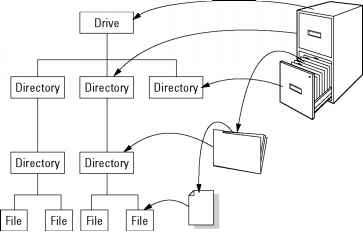
The files and directories in your PC store information in an organized manner just like paper filing systems. When you store information on paper, you typically put several pages in a folder and then save the folder in a file cabinet. If you have many folders, you probably have some sort of filing system. For example, you may label each folder's tab and then arrange them alphabetically in the file cabinet. You probably have several file cabinets, each with lots of drawers, which, in turn, contain folders full of pages. Operating systems such as Linux organize information in your computer in a manner similar to your paper filing system. Linux uses a file system to organize all information in your computer. Of course, unlike a filing cabinet, the storage medium isn't a metal cabinet and paper. Instead, Linux stores information on devices such as hard drives, floppy-disk drives, and CD-ROM drives.
Logging with syslogng
Another really useful feature of syslog-ng, especially if you are setting up a centralized logging host, is that you can save the messages to a specific file in a specific directory based on where the messages originated. All of these things add up to a more granular experience for organizing your log files with syslog-ng.
Dealing with errors in packages
The option to deinstall a package with broken control scripts does not really exist when a package's removal scripts are the ones causing problems. Even though you could force the removal by causing the offending control script to exit cleanly, this would prevent dpkg from cleaning up your system properly, potentially leaving orphaned files behind. Short of fixing the problem (and submitting a patch to the bug tracking system), it is probably best to report the problem (see chapter 10.6) and wait for an updated, fixed version to percolate into the archive. Then, the package may be removed as it should. This only holds for the postrm script, however. If the prerm script is broken, you will have to simulate its successful completion to make the upgrade to the next package version work.
Stopping Incoming Spam
Description The MAPS Relay Spam Stopper (RSS) lists sites that are known to be open relays that have been used at least once by spammers. Open relays that have not been used by spammers are not on the RSS list. Unfortunately, a large number of legitimate sites are poorly configured, and some of these find themselves on the RSS. Fortunately, most such sites quickly clean up their servers and are removed from the RSS. The RSS therefore produces occasional false alarms.
Passing Parameters to printf
The ADD instruction at the end of the sequence represents what you'll hear described as ''cleaning up the stack.'' Each time we push something onto the stack with a push instruction, the stack pointer ESP moves toward low memory Not well If you forget to clean up the stack, or if you clean it up by the wrong number of bytes, your program will almost certainly throw a segmentation fault. Details dare I call it neatness count
The Samba smbconf Configuration File
In the smb.conf file, global options are set first, followed by each shared resource's configuration. The basic organizing component of the smb.conf file is called a section. Each resource has its own section that holds its service name and definitions of its attributes. Even global options are placed in a section of their own, labeled global. For example, each section for a filespace share consists of the directory and the access rights allowed to users of the filespace. The section of each share is labeled with the name of the shared resource. Special sections, called printers and homes, provide default descriptions for user directories and printers accessible on the Samba server. Following the special sections, sections are entered for specific services, namely access to specific directories or printers.
The Full Shell Script
Let's start at the Beginning of Main in Listing 20.9. The very first thing that we do is set a trap. This trap is set for exit codes 1, 2, 3, 5, and 15. On any of these captured signals the cleanup function is executed, and then the shell script exits with a return code of 1. It is nice to be able to clean up before the shell script just exits.
Using and Managing Your Calendar
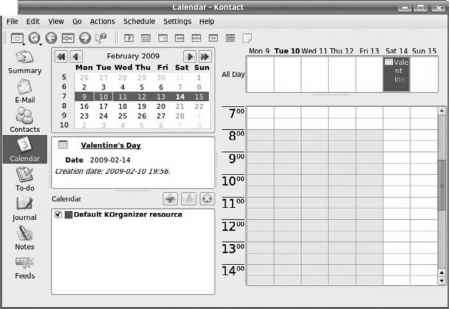
Managing one's calendar and To-Do items is an important part of a personal information management application because remembering where you have to be and what you have to do is a fairly critical aspect of getting organized in the first place. As mentioned earlier, managing your calendar, To-Do list, and even a journal is supported in Kontact through an integrated application known as KOrganizer, which is simply known as the Calendar application in Kontact. Kontact's Calendar application lets you manage all of these things locally and, like the Contacts application, also supports integration with centralized calendar resources. For information abut configuring the Calendar application, see the section earlier in this chapter entitled Configuring Your Calendar .
Launching the GIMP
Swap Directory Data that doesn't fit into the tile cache is stored on disk in a swap directory. The default value is .gimp-1.2, but you might want to change this to tmp or var tmp. Doing so will enable your distribution's automatic routines for cleaning up these temporary directories to remove any files that are left over in the event of a program crash. On the other hand, if space on the tmp or var tmp partition is limited, leaving the swap directory at its default may be wiser.
The Server
As before, if we run into any problems writing to the client, we close the socket and continue listening for other connections. Once our file has been sent, we'll clean up the file descriptor and close the second socket. Our server will loop back and check for more connections on socketl until it receives a termination signal from the operating system. Once the termination signal is received, we'll clean up by closing the original socket (socketl), and exiting.
Starting with INN
Cron Three entries exist for cron (two daily and one hourly). The two daily entries, in etc cron.daily, clean up the news service (remove old entries) and check that the news service is working once a day. The one hourly cron entry checks that the news service is running and then sends news articles to other NNTP sites.
Asa Computers
Now, what would a column about splits be if I didn't show an insanely complicated nested set of split screens Note that I don't advocate actually using a setup like the following on a daily basis, but Figure 4 shows what happens when you split screen into two windows, open a split irssi on the top window and a vertically split vim on the bottom. I hope these split-screen features help you stay organized and productive.
Filesystem Types
Finally, there is a slew of filesystems for accessing data on partitions these are created by operating systems other than the DOS and Unix families. Those filesystems support the Acorn Disk Filing System (ADFS), the AmigaOS filesystems (no floppy disk support except on Amigas), the Apple Mac HFS, and the QNX4 filesystem. Most of the specialized filesystems are useful only on certain hardware architectures for instance, you won't have hard disks formatted with the Amiga FFS filesystem in an Intel machine. If you need one of those drivers, please read the information that comes with them some are only in an experimental state.
Unmounting Devices
Another way of forcing the umount command to do its work is to use the -f option. The umount -f somemount command will force the unmount to occur. This option is made in particular for use on an NFS network mount that has become unreachable and does not work on other file systems that are busy. Another nice option, especially if you don't like to hurry, is the -l option. You can use this option to do a lazy unmount, it will detach the file system from the file system hierarchy and clean up all references to the file system as soon as it is not busy anymore. Using this option allows you to do an unmount now, even if the file system is busy.
Playing Music
Another way to organize your music is by creating playlists. Playlists are simply collections of music files from your library. The way they are organized allows you to play the entire collection of music from that specific playlist at one time. Playlists are great for organizing genres of music, or for mood music. This way, you can make sure that when you are in the mood for aggressive rock music, Core 'ngrato doesn't find its way into the mix.
Server Basics
It is under these circumstances that a system administrator finds their responsibilities lying somewhere between deity and janitor. Ultimately, the sysadmin's job is to provide access to system resources as quickly (and equitably) as possible. This job involves both the ability to design new systems (that may or may not be rooted in solutions that already exist) and the talent (and the stomach) for cleaning up after people who use that system without any concept of what resource management really means. 19. Cleaning up after ex-users Kernel Tuning
Usenet News
Usenet is an open mail system on which users post messages that include news, discussions, and opinions. It operates like a mailbox that any user on your Linux system can read or send messages to. Users' messages are incorporated into Usenet files, which are distributed to any system signed up to receive them. Each system that receives Usenet files is referred to as a site. Certain sites perform organizational and distribution operations for Usenet, receiving messages from other sites and organizing them into Usenet files, which are then broadcast to many other sites. Such sites are called backbone sites, and they operate like publishers, receiving articles and organizing them into different groups.
Virtual Desktops
The block of numbers (1, 2, 3, and 4), collectively known as the pager icon, that follows the row of panel icons represents the virtual desktops. Initially, you may question the need for more than one desktop, but you'll learn to love the extra real estate additional desktops provide, as well as their ability to help you stay organized.
AIX Paging Monitor
Clean up the data by removing the suffixes PAGING_MB (echo TOTAL cut -d 'MB' -f1) PAGING_PC (echo PERCENT cut -d -f1) There is one part of our shell script in Listing 6.3 that we have not covered yet. At the top of the script where we define variables, I added the PC_LIMIT variable. I normally set this threshold to 65 percent so that I will know when I have exceeded a safe system paging space limit. When your system starts running at a high paging space level, you need to find the cause of this added activity. Sometimes developers do not write applications properly when it comes to deallocating memory. If a program runs for a long time and it is not written to clean up and release allocated memory, then the program is said to have a memory leak. The result of running this memory leak program for a long time without a system reboot is that your system will run out of memory.
Adding Desktop Icons
Create Document Clean Up by Name Keep Aligned Paste You can place new icons anywhere on the desktop you choose. The Clean Up by Name feature reorganizes the desktop to place folder icons first, then arranges application launcher and document icons alphabetically by name. If the Keep Aligned option is selected, Ubuntu aligns any icons placed near other icons using the same spacing as when it cleans up the desktop.