Laptop Repair Made Easy
Laptop Repair Made Easy

This productis handled by a specialized laptop repair technician. Typically, a hardware fault requires the physical review of a laptop and testing for abnormalities. Suspected components, such as random access memory (RAM), hard disk, power supply or optical drive may be individually checked, troubleshooting or replaced if an error is detected. This usually requires special equipment and accessories to disassemble and reassemble the computer. The easy-to-repair laptop product is a trusted product, effectively providing the fundamental skills needed to solve problems and problems on a faulty laptop. This product has long been a stressful job, to reduce stress, the author had explored and created this awesome package that has been found to be effective by many users as it contains new and improved techniques to suit your tastes. This product is consistent and efficient in its mode of operation. Being a machine, it does not suffer from the human trait of tiredness and lack of consideration. It will perform the last task with same speed and accuracy as the first given to it, no matter the number of times it has to do it, The product can store and process large volumes of data without being affected. Laptop storage capacity has even increased considerably in recent times. This is as a result of large and complex software being developed nowadays. More here...
Laptop Repair Made Easy Summary
Contents: Ebook
Author: Thomas James
Official Website: www.laptoprepairmadeeasy.com
Price: $47.00
My Laptop Repair Made Easy Review

It is pricier than all the other books out there, but it is produced by a true expert and includes a bundle of useful tools.
In addition to being effective and its great ease of use, this eBook makes worth every penny of its price.

Linux on Laptops and PDAs
One of the definitive sites for getting information about running Linux on your laptop is Kenneth Harker's Linux Laptop site. Although not as actively updated as in the past, this site (http www.linux-laptop.net ) still contains the world's largest collection of Linux and laptop information, with links to user experiences and details concerning specific laptop models.
Finding Linux Compatible Laptops
One comment that echoes from Linux users of all distributions is the difficulty of configuring the hardware on a laptop. Laptops are an unusual beast in that most of their hardware is integrated together video, sound, and modems. Other devices include infrared (IR) port PCMCIA devices like network adapters SCSI and modems. In some cases, these components may be slightly different from the desktop models. For example the video card on a laptop may use a different clock circuit or have limited capabilities specifically to work with the laptop. Additionally, laptops use features such as power management, battery life monitors, and other functions specifically geared toward laptops. Debian offers many tools for laptop use, which you can include when you install the system. These applications are intermixed with the rest of the Debian packages. Several resources are available specifically oriented for laptop use. Table 17-2 shows some of the laptop models used with Linux.
Power Management for Laptops
SUSE Linux configures laptops for saving power and prolonging battery life, whether you have an APM or ACPI system (see the earlier 'YaST Power Management section if you missed those definitions). The YaST Power Management module lets you tweak those settings. ACPI Settings Defines what actions occur when you press the Power and Sleep buttons, or when you close the laptop cover. Use the drop-down menu to choose from the same actions used in Battery Warning (Notify, Shutdown, Logout, Standby, Suspend to RAM, Suspend to Disk, Start Screensaver, Ignore).
Synchronize files between a laptop and desktop PC
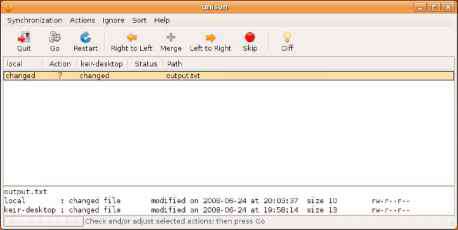
If you have two computers you might want to synchronize data between the two. For example, if you have a laptop, you might want to transfer the files in your Documents folder to the main PC (and vice versa). You These instructions make reference to a desktop PC and laptop computer, but could be any two computers capable of running Ubuntu (or indeed any computer with Linux installed that can run Unison) 1. On the desktop PC, use Synaptic to install the unison-gtk package. Meanwhile, on the laptop, use Synaptic to install the openssh-server and unison-gtk packages. As you might have guessed, Unison uses SSH in the background to provide the file transfer conduit. If you want to learn more about SSH, see Tip 190, on page 228. 3. In the next step, you must tell Unison which folder you want to synchronize with on the laptop. in the Directory text field, type Documents again.
Monitoring power usage on laptop computers
To effectively use a laptop computer, you need to be able to monitor and manage the laptop's power usage. Using tools provided in Fedora or RHEL, you can configure your laptop to Show when the laptop is plugged in. Advanced Power Management (APM) APM can be used to monitor the battery of your notebook and notify user-level programs to tell you when your battery is low. It can also be used to place your laptop into suspend mode. Advanced Configuration and Power Interface (ACPI) Besides monitoring power features on your laptop, ACPI can also do thermal control, motherboard configuration, and change power states. Many older laptops do not include support for ACPI in the BIOS, so you must use APM to monitor and manage your batteries. For some newer laptops, ACPI may be required. In general, ACPI offers a more complete feature set for power management, but APM has more user-level support today. The following procedure was performed on a laptop that used ACPI to manage power events.
Laptop Mode
Laptop mode is a special page writeback strategy intended to optimize battery life by minimizing hard disk activity and allowing hard drives to remain spun down as long as possible. It is configurable via proc sys vm iaptop_mode. By default, this file contains a zero and laptop mode is disabled. Writing a one to this file enables laptop mode. Laptop mode makes a single change to page writeback behavior. In addition to performing writeback of dirty pages when they grow too old, pdflush also piggybacks off any other physical disk I O, flushing all dirty buffers to disk. In this manner, pdflush takes advantage of the fact that the disk was just spun up, ensuring that it will not cause the disk to spin up later. dirty_writeback_centisecs are set to large valuessay, 10 minutes. With writeback so delayed, the disk is spun up infrequentlyand when it does spin up, laptop mode ensures that the opportunity is well utilized.
Photo Editing Overview
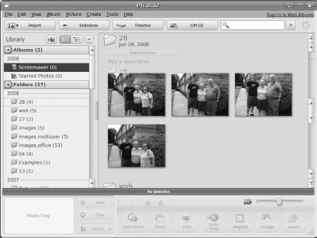
Although many of us probably still have envelopes stuffed with old holiday and vacation photographs that have been glued together by time and humidity, it's been a long time since I've had to deal with film. I'm probably showing my age by mentioning it at all. I have a few generations of digital cameras with increasing resolution, my cell phone has a camera, my laptop has a camera, and even a wristwatch that I bought during an eBay seizure a few years ago has one. Digital photography makes it incredibly easy to archive, catalog, and share your photos while also reducing the number of items that you can't find when you want them they're all on your computer.
Basic Kernel Concepts
There are a substantial number of kernel-related packages available. The packages, names, and versions will vary by release. The names cited here are listed as extensions to files in the boot directory. For example, the generic kernel image is the standard for Ubuntu desktop or laptop systems the associated kernel image file for the first Hardy Heron release is boot vmlinuz-2.6.24-16-generic. The corresponding server kernel image file, vmlinuz-2.6.24-16-server. And remember, as this is a book on Ubuntu Server, I use that kernel in this book. (I also use the kernel released with the first Hardy Heron update, 8.04.1, version 2.6.24-19-server.) The fourth number (-16-server) is added by Ubuntu. In this case, it's the sixteenth build of Linux kernel 2.6.24, customized for Ubuntu Server. Other Ubuntu builds include a different fourth number, such as -16-generic for desktop laptop systems.
Create a Virtual Machine on KVM
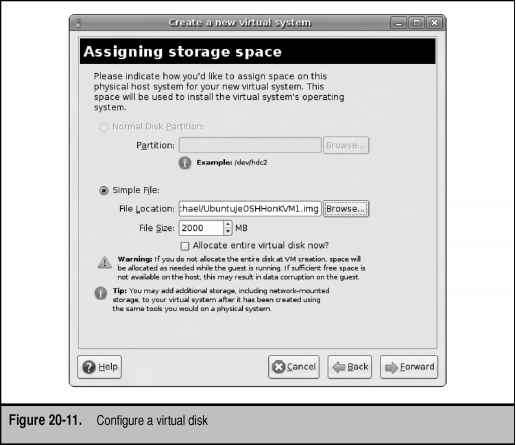
This section illustrates two methods to create a virtual machine, using KVM modules and utilities. I've tested these methods on my laptop system with a dual-core CPU. I use the Ubuntu JeOS system and ISO file described earlier for this purpose. One advantage of JeOS is that it requires relatively few resources. I illustrate the configuration of a virtual machine from the command line using the virt-install command as well as the GUI Virtual Machine Manager, which can be started with the virt-manager command. Other tools are available, including the ubuntu-vm-builder command however, the focus here is on the virt-install command as it is so closely related to the GUI Virtual Machine Manager. For the purpose of this chapter, I've installed the Ubuntu JeOS operating system on my laptop in fully virtualized mode. To do what I did, you'll need a system with a CPU (and for Intel-based systems, a BIOS) with virtualization enabled.
Watching the Protocols with tcpdump

In Listing 13.16, the monitoring system sees the ARP broadcasts and the unicast ARP replies, as well as all of the ICMP traffic caused by the ping. Notice the time difference of the time stamps on the packets from the failed example to the example shown in Listing 13.16. Almost 30 minutes elapsed while the switch was reconfigured to allow monitoring. During a real emergency, 30 minutes is an eternity. Many network administrators preconfigure a port to act as a supervisory port. When a problem occurs, the administrator can plug the laptop that he uses for testing into the waiting port.
Configuring Power Management
The Power Management Preferences dialog provides two or three tabs the On AC Power tab which enables you to configure how your system behaves after significant periods of inactivity when it is running from AC power (i.e., when it is plugged in), On Battery Power, which is displayed only on laptop systems and which enables you to configure how your system behaves after significant periods of inactivity when it is running from battery power, and the General tab, which enables you to configure how your system should react when the Power or Suspend buttons are pressed, and whether a power management icon is displayed in the notification area at the upper right of the top GNOME panel. The On Battery Power tab displays only if you are using a laptop or similar computer, and offers the same settings as the On AC Power tab. In addition, it enables you to select the actions that your system should take when the laptop lid is closed and when battery power is critically low.
Improving Disk Performance
If Linux isn't running your disks in an optimal mode, you can use hdparm to adjust its settings. In some cases, you can apply driver-specific options to your ATA driver. Finally, one issue of disk performance doesn't relate to speed, but it is important to laptop users energy use. You can configure the disks to spin down when they haven't been accessed for some time, thereby saving energy. Normally, a computer's hard disks spin whenever the computer is turned on. This feature makes disk access swift, because there's no need to begin spinning the disk to access a file however, it consumes a fair amount of power. Therefore, as an energy-saving measure, spinning down a disk when it's not in use is sometimes desirable. Doing so is particularly helpful on laptop computers, on which a spinning hard disk can greatly reduce battery life. Therefore, hdparm supports the -S option to set this feature. Unfortunately, the encoding of this feature is rather odd, as outlined in Table 2.4.
Configuring and Using DHCP Services

Today's networks are more complex than ever before. In addition to traditional requirements that each user's desk top system be connected to the network, many other devices such as printers, fax machines, laptop and notebook computers, and personal digital assistants (PDAs) now typically require network connections. Because today's networks typically use numerous IP addresses, system administrators must manage the set of IP addresses available to them more effectively within an enterprise and on specific network segments. Devices like PDAs and notebooks, laptops, and other portable computers bring special requirements to network administration, because they are not always connected to the network and almost always move from place to place.
Mangle Table Listing Formats
3 0 0 MARK tcp -- eth0 any laptop.private.lan anywhere tcp spts 1024 65535 dpt ssh MARK set 0x10070 Line 3 is a MARK rule to alter the mark value that iptables associates with SSH packets arriving on the incoming interface. SSH client connections from the local laptop addressed to anywhere are assigned the mark value 0x10070 .
Specialized Wireless Auditing LiveCD Toolkit
Most of the tools involved in conducting wireless hacking and auditing are designed for Linux first and then a few get ported to Windows. This presents a challenge for those who are limited in installing Linux onto a machine, e.g., the machine belongs to the company and they have strict policies and enforcement regarding the loading of software onto company laptops or the repartitioning of company-supplied-laptop hard drives. Tools are all in one location under usr local apps, making for easier log or packet dump file access. You don't need to install any software on your laptop or modify your laptop hard drive.
Smart Hard Disk Monitoring
When I run this command on my laptop, I get a long output, which is the reason to pipe the output to the less command. It allows you to scroll through the output with the pageup pagedown and up and down arrow keys. One excerpt from the output is shown in Figure 3-3. Without getting into too many details associated with hard drive performance, the data shown in Figure 3-3 show that my laptop has run with this hard drive for 1807 hours, with a Load_Cycle_Count of 89070. Wait a second the Load_Cycle_ Count variable is associated with load and unload cycles, as the drive is powered up and down. The specifications for the hard drive in question note that hard drives may fail with a load cycle of over 600,000 cycles. I leave my laptop on most of the time, so it means my hard drive will fail in a couple of years. Others have reported more substantial problems. So we add the following On The Job
Using the battery status applet
O Show a power cord if the laptop is plugged in. o Warnings Select whether or not you want to be notified (with a pop-up) when the battery charge is low or fully charged. You can also select to have the laptop beep if either case is true. o Suspend command Add a command to put the laptop in suspend mode. (Try the apm -s command as described in the next section.) With a Suspend command set, you can right-click the icon and choose Suspend Computer to suspend your laptop. Note If, when you try to add the Battery Charge Monitor icon to the panel, a pop-up window tells you that the operation fails, it may be that the apmd daemon isn't running. You can try starting the apmd service (as root user type service apmd start). If, however, APM is shown as not supported in your dmesg file, you can try turning on APM support in your laptop's BIOS.
Reading ACPI Event Files
Regulates basic hardware, including hard drives, laptop mode (power standby), and PPP connections Read at least a few of the individual laptop event files. You'll see links to common manufacturer-independent scripts. For example, the ibm-sleepbtn, panasonic-sleepbtn, and sony-sleep events all link to the sleepbtn.sh script in the etc acpi directory. None of this works without a map not a geographic map, but a file that associates the signals from a hot key to an ACPI support event described in the etc acpi support directory. Maps for various laptop manufacturers have been collected in the hotkey-setup package.
Putting It All Together
Like beer making, no special equipment (apart from a laptop and Internet connection) is needed to create your image. Choosing a good beer recipe and following good brewing procedures can give you top quality beer even with basic equipment. The same principles apply to creating a custom image. Other useful resources include the Hardware Compatibility Lists, or HCL. These list the hardware components, parts, and add-ons that are used in netbooks, MIDs, PDAs, mobile phones, media players, GPS devices, and wearables. For example, to check webcam support for a device, go to http tuxmobil.org laptop_webcams_linux.html . Choose the target device if listed. Clicking the Acer Aspire One ZG5 link gives all types of information about the hardware on the device.
Backing Up with unison
It's common for people to want to work with the same documents on their laptop and desktop systems. Those machines might even run different operating systems. Because unison is a cross-platform application, it can let you sync files that are on both Linux and Windows systems. To use unison in Fedora, you must install the unison package (type the yum install unison command).
Update and Manage Clients
Local repositories are configured in the etc apt sources.list file. It's a fairly straightforward file the following is an analysis of a version of this file available just after Ubuntu Linux Gutsy Gibbon was installed on my older laptop system. While I cover only active commands, this file also contains several comments, which are suggestions for alternative commands
GNOME Power Management
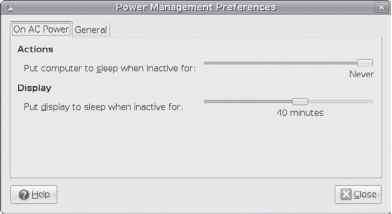
Ubuntu uses the GNOME Power Manager, gnome-power-manager, which makes use of Advanced Configuration and Power Interface (ACPI) support provided by a computer to manage power use. The GNOME Power Manager is configured with the Power Management Preferences window (gnome-power-preferences), accessible by choosing System Preferences Power Management. Power Manager can be used to configure both a desktop and a laptop. On a laptop, the battery icon displayed on the top panel will show how much power is available on the battery, as well as when the battery level becomes critical. It will also indicate an AC connection as well as when the battery has been recharged. For a desktop, two tabs appear in the Power Management Preferences window On AC Power and General. The On AC Power tab offers two sleep options one for the computer and one for the display screen. You can put each to sleep after a specified interval of inactivity.
Using Power Management Preferences
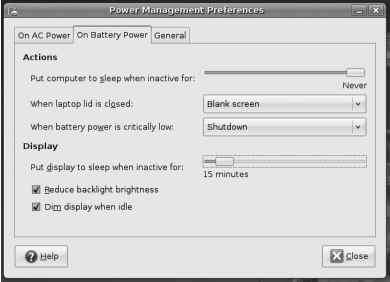
Of time and will also allow you to configure your notebook to enter sleep (standby) mode. In addition, if you use a notebook computer, Ubuntu might let you configure additional aspects of your computer, such as the display brightness. These functions are controlled using the Power Management applet. To start this, click System Preferences Power Management. If Ubuntu is installed on a notebook computer, you'll see three tabs in the program window On AC Power, On Battery Power, and General. If Ubuntu is installed on a desktop computer, you'll see just the On AC Power and General tabs. If your computer is a notebook computer, you'll see some extra options. Depending on the technology used in your computer, you might see a Set Display Brightness To slider, which you can use to set the brightness of the screen when the power is connected. Whenever AC power is connected, the display brightness will be changed to match this setting.
Partitioning the hard disk drive
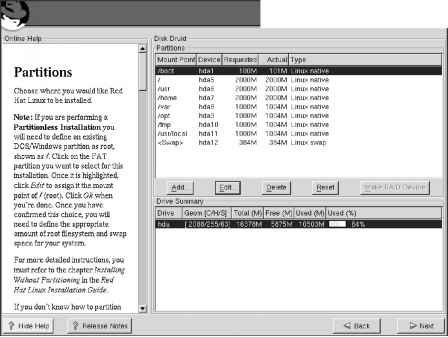
The next step in your installation is to partition the hard drive. This is performed automatically for Workstation, Server, and Laptop installation classes. The automatic configuration standards that can be set up by selecting a Workstation, Laptop, or Server class, however, usually won't work if the hard drive has an existing partition. At this point in the installation, or if a custom installation has been selected, a manual configuration of the partition must be performed. Disk Druid and fdisk are the usual partition utilities that are offered at this point, but others may be presented depending on your distribution. Disk Druid is the recommended tool for most users and is an easy-to-use and capable partitioning tool. Disk Druid is illustrated in Figure 4-6.
GNU Network Object Model Environment Gnome A common desktop environment for Linux
Laptop computer A small portable computer, typically somewhat smaller than a briefcase. Laptops use special miniaturized components. Special software requirements of laptops include power management (APM or ACPI) and Card Services. A laptop computer is also known as a notebook computer. liquid crystal display (LCD) A type of flat-panel display that's common on laptops and is becoming more common on desktop systems. LCDs are lightweight and consume little electricity, but they're more expensive to produce than are conventional monitors.
Disks Partitions and Mount Points
The bottom line of any computer system is storing, retrieving, manipulating, and saving information. As a writer and computer systems administrator, I'm always amazed when friends who are generally computer savvy say to me, Your laptop is so slow. Why don't you upgrade Frankly, if I could type faster than my primary laptop's 1.4 GHz Pentium processor could handle, I'd be posing for Ripley's Believe It or Not ads or touring with the circus instead of writing books. On the other hand, if it took five minutes for me to save a chapter of whatever I'm working on or if I could never find the space to save a modified file without deleting something else, I'd drop-kick my current laptop into the river in a heartbeat and buy the newest, brightest, shiniest Linux-capable laptop available today. For what I do, being able to reliably and quickly read and write data is far more important than blazing CPU speed.
Manual Display Configuration
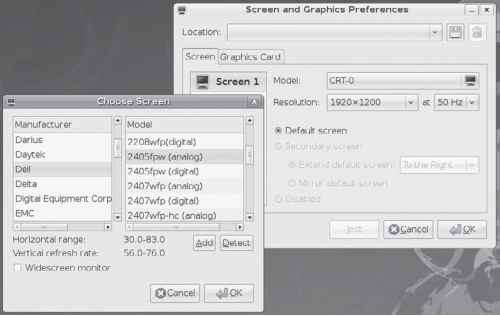
You also have the option of creating different location profiles. This is useful if you are using different monitors at certain locations or for different purposes. So, for example, your laptop could have one location for its own screen and another for an attached larger screen. Others could use one location for a standard PC monitor and another for a home theater display such as an LCD TV.
Apropos Searches for a Keyword
The database apropos uses, named whatis, is not available on Fedora RHEL systems when they are first installed, but is built automatically by crond (page 565) using makewhatis. (The cron utility runs the etc cron.daily makewhatis.cron script to build the whatis database.) If you turn the system off periodically (as with a laptop), the script may not be run. If apropos does not produce any output, run the command makewhatis -w while working with root privileges.
Graphical Process and System Management Tools

A handy little application is the xosview client, which provides load, CPU, memory and swap usage, disk I O usage and activity, page swapping information, network activity, I O activity, I O rates, serial port status, and if APM is enabled, the battery level (such as for a laptop). You will have to obtain xosview using either synaptic or apt-get.
The Inside Security Rescue Toolkit
The Fluxbox window manager offers some docked system monitors for monitoring CPU, network traffic, memory and swap use, and battery (if you are on a laptop). Another applet displays the Matrix screensaver (double-click it to launch a Terminal window). The mount applet lets you step through the CD, floppy, and hard disk partitions on your computer. Click the key button on that applet (so it turns green), and you can double-click it to mount and open that device or partition.
Keyboard shortcut to File Manager in Ubuntu Windows E for Nautilus
If you read my earlier post, you know I recently upgraded my work laptop from XP to Ubuntu (although I am sticking to the 10.4 LTS on my work laptop 10.10 is working fine on one of my personal machines). I am still planning a more inclusive update that details all the subtle changes I ended up making and a review of how the transition has been, but I thought this deserved its own post.
Handbrake
S an animation and comic-book fan, I like to watch various TV shows and movies featuring my favorite characters, ranging from the Simpsons and Superman to Looney Tunes and the X-Men films. Like most such fans, I've also bought the various DVD releases of these shows. However, since I'm not always at home, I also like watching TV programs and movies on my laptop or Palm Pre smartphone. It's great to be able to watch films while on vacation and other trips, or cartoons while commuting on the bus to work. Instead of repurchasing digital download versions of these programs, however, I find it's much cheaper (and easier, when factoring in the lack of Linux-friendliness of some on-line digital video stores) to convert my DVDs into more versatile, computer-ready video files.
KDE Control Center
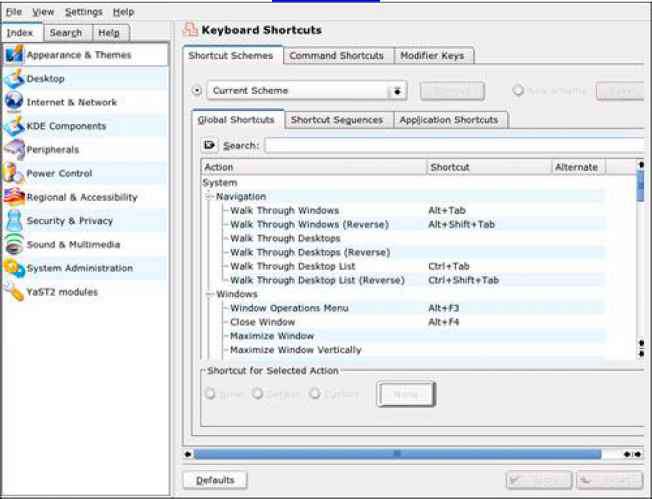
The Internet and Network area lets you configure Konqueror's web-browsing functions, share your desktop with other KDE users on the network, and set up your Samba client configuration for accessing Wndows shares on your network (SuperUsers can also configure a Samba server). If you're on a laptop with Bluetooth capabilities, you can add and manage your Bluetooth services here as well. the screensaver and monitor when not in use, are located under Display (and laptop power controls are in Power Control). Regional and Accessibility settings define your keyboard layout and how times, dates, and money are displayed depending on the norm for your country. Set keyboard shortcuts for various KDE functions in the Keyboard Shortcuts section and define other keyboard shortcuts and mouse gestures in KHotKeys, a new addition. Figure 6.11 shows the Keyboard Shortcuts screen.
Reviews
Cruising for hotspots on a Linux Laptop can be a royal pain. It's not that we don't have good Wi-Fi sup-port we do it's more that a lot of places offer free Wi-Fi with strings and dongles. My favorite coffee shop for working in, for example, offers free Wi-Fi to customers, and they control access by means of PCMCIA cards with the router set to allow only those MAC addresses. Leaving aside the fact that I have no way to install their Windows-only drivers, my laptop sports only an ExpressCard slot, so I'm pretty much screwed no matter what. I recently discovered, much to my delight, that such a device does exist. The Cradlepoint PHS300 PHS standing for Personal HotSpot is a compact little router that, once turned on, establishes a solid wireless cloud suitable for use by anyone with a properly equipped laptop or other Wi-Fi-enabled device (www.cradlepoint.com phs300 phs300.php). It's not easy to Imagine what they could have done better.
Raster Scan Display
The monitor is the physical device that contains the display screen where the graphic and text output appears. The display screen is typically a phosphor-coated glass tube on which an electron beam traces the output image. On laptop computers, the display screen is a liquid crystal display (LCD). More expensive laptops use active-matrix LCD-display screens.
Setting Up SCPM
SUSE Configuration and Profile Manager (SCPM) is a profile manager for the SUSE system. Profiles allow you to define multiple configurations for the same system and switch between them. This is particularly useful for laptop users who, for example, need different network, proxy, and printer settings at home and at work.
The panel
To create a new panel, click any blank space in an existing panel, and choose Panel Create New Panel, then select the type of panel you would like. To change a panel's properties, such as its size and color, right-click it and choose Properties (the menu panel at the top of the screen has no available properties it is preconfigured for one position and size). Experiment with different kinds of panels and with different sizes to see which ones you like best. If you use a smaller screen, like a laptop screen, you will want to choose a smaller panel size than if you have plenty of screen real estate to use. The Battery Charge Monitor displays the remaining battery life for laptop systems. Options include display as a chart, as a percentage, or by estimated usage time remaining.
Power Control
The Power Control module basically does what you would think, given its title, depending on your specific installation. You can monitor your batteries ( especially useful for laptops), configure your power-saving features, control power settings for your laptop, or set an alarm to alert you when your batteries get too low. Most of these settings have to do with laptops, but the Energy setting will allow you to control how long it takes for your display to go into sleep mode. To get out of this power-saving mode once it has activated itself, all you need to do is move your mouse or press a key.
Using Pcmcia Cards
PCMCIA (Personal Computer Memory Card International Association) cards are the original mechanism designed to support removable and insertable interfaces in portable computer systems. PCMCIA cards are now often just called PC Cards because no one can ever remember what the acronym means (as suggested by the optional PCMCIA expansion, People Can't Memorize Computer Industry Acronyms ). Thanks to the rise of USB, PCMCIA cards aren't as common as they once were, but they're still a standard feature in many laptops.
PCI Hotplug
PCI hotplug systems are becoming more popular with the use of ExpressCard and laptop docking stations. 3. There is a wide range of different types of PCI hotplug controllers. For most laptops and for ExpressCard support, enable the ACPI controller PCMCIA and CardBus device support is in almost every laptop manufactured. Newer laptops, however, are switching to the ExpressCard format (see the PCI Hotplug recipe in the previous section, PCI Hotplug ). Enable the card bridge type for your laptop. The most common one is the yenta-like controller
Creating Graphics
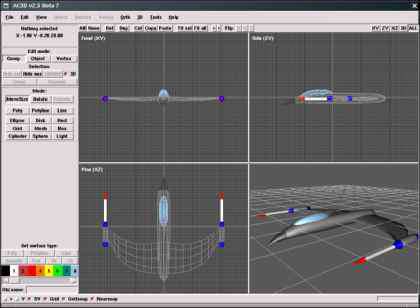
After creating the ship model in AC3D, I exported it to POV-Ray, manually tweaked the camera position in the .pov file, and added a clock variable to allow it to be automatically rotated. I wrote a script to automatically render 96x96 images of the model in 4-degree rotation increments (thereby saving the tedious work of rotating the model by hand). The entire rendering process took only a few minutes on a fast laptop. Finally, I used the free ImageMagick package to assemble the individual ship images into one long strip, saved as a bitmap file. I developed this particular procedure throughout several of my own projects, but there are other ways to go about the task of creating 3D graphics with POV-Ray. POV-Ray is worth learning. It can be a great tool for creating prototype graphics, even if you are not a graphic artist, and it can produce amazing images in the hands of a master.
Mandrake KDE
The top left is the battery monitor if you're using a laptop. The bottom left is the Klipper clipboard tool. The top middle is the PCMCIA profile manager. The bottom middle is the SuSEWatcher updater tool. The top right is the volume control, and the bottom right is the SuSE hardware management tool.