Get Paid to Write at Home
Paid Online Writing Jobs

More Information
Making some extra money from your home isn't a bad idea at all. And we have the answer to the question that you have been asking yourself. Where to find all these good-paying internet jobs? Given you can write English at a third-grade level or above, PaidOnlineWritingJobs.com is where you can find thousands of lucrative jobs right from the comfort of your sofa. As you might have noticed, it is an online writing-jobs website that offers memberships to eager learners and doers like you. The process is very simple. There is no hassle whatsoever.That's because the owners of the website have only one thing in mind: to help you earn a handsome amount of money by utilizing your current time at home. From where do they get their orders, you might ask? The company has been in the business for far too long to cultivate healthy relationships with blogs, and other companies. They have earned their trust and since they continually provide them with talented writers like you, they never run out of orders at all.The choice is always yours, which means you can work according to your interest.All you have to do is join PaidOnlineWritingJobs.com, start working immediately on any of the thousands of topics available, and get your compensation weekly right in your PayPal or bank account. Read more...
Contents: Online Platform
Official Website: clicktrixredirects.com
Price: $4.95
Access Now
Paid Online Writing Jobs Review

Furthermore, if anyone else has purchased this product or similar products, please let me know about your experience with it.
I feel totally comfortable and confident in recommending Paid Online Writing Jobs knowing it can be so helpful if you fully apply what they share.
Read full review...
Translate 4 Cash

Translate 4 Cash is an online platform that offers a broad range of translation services. It allows you to translate strings of texts and documents from English to several languages and vice versa. Translate 4 Cash has been designed to focus on simplicity, as many of the options found on other platforms can be confusing initially. It provides users with a convenient interface to easily switch between different languages and the associated options. Various status indicators help users to track their progress. Kenny Tan is one of the pioneers of Translate 4 Cash, who has always had a practical mindset toward making money. Through his own experiences, he discovered the inefficiencies of the world's paper-based translation services. He saw a need for a simpler and more convenient way to carry out translations; thus, Translate 4 Cash was developed. From its conception to date, it has grown into one of the most sought-after translation platforms in the world today. Translate 4 Cash is in the form of software that can be accessed using software that runs on your computer or through an app. You will first have to register with the platform, and then you will be able to access the software. You will need to make the necessary payments to access the software. Read more...
Translate 4 Cash Summary
Contents: Job Opportunity
Creator: Kenny Tan
Official Website: translate4cash.live

Word Processing with Open Officeorg Writer
OpenOffice.org (www.openoffice.org ) is a suite of office applications including a word processor (Writer), a spreadsheet (Calc), a drawing program (Draw), software for creating presentations (Impress), and a database program called Base, which keeps tagging along after the rest of OpenOffice. This section focuses on the word processing application other chapters in this book discuss the OpenOffice.org spreadsheet, graphics, and presentation software. But first, a word from our sponsor. Aside from its power and the absence of cost, a truly compelling reason for using OpenOffice.org Writer is its use of the new OpenDocument Format (ODF) standard for storing and exchanging documents ). Historically, all word processors used their own proprietary binary formats for storing documents, which made it a hassle when switching from one word processor to another or when simply trying to exchange documents with friends or coworkers who used a different word processor.
Launching Open Office Writer
Click the OpenOffice Writer icon to launch the application. Click the taskbar icon the splash logo appears as the application loads. When the program is loaded, a new Writer application window containing an untitled document appears, as shown in Figure 12.2. A new OpenOffice Writer window. Because no document has been loaded by the user a new document Untitledl appears in the application window. The following are components that make up the OpenOffice Writer window The stylist window (which is titled Paragraph Styles) is helpful for long and complex documents requiring many different text styles, but we're not going to discuss it in this text. You can close it by clicking on the small button at its upper-right corner. If you want to experiment with it later on, you can display it once again by selecting Format, Stylist from inside OpenOffice Writer. You can also toggle the stylist off and on by pressing your F11 key.
Database Writer Process DBWn

The database writer (DBWn, also called DBWR) writes modified (dirty) blocks from the database buffer to disk. DBWR does this to clear out old dirty blocks to make room for new blocks in the cache. The DBA should note that this includes both committed and uncommitted data. There is normally one database writer process per database instance, but up to 10 DBWRs may be configured. Also, DBWR slave processes may also be used in some cases. These options are further described in Chapter 11.



Working with Writer Files
One of the great things about Writer is that it can work with many file types. This capability allows you to create documents that can be used with various types of word-processing systems. Not only can you save new documents in various formats, but you can also read documents created in other word-processing programs. Here's a list of the document types you can use with OpenOffice.org Writer Microsoft Word 97 2000 XP (.doc) format yes, you can read and write Word documents using Writer The versatility of Writer is one of its primary features. You're not locked into a specific document format or style when you use Writer. Although the option is not available in the Save As dialog box, the OpenOffice. org Writer toolbar allows you to export any format of document to the PDF document format. You can create PDF documents from your Writer documents by pressing the Export Directly as PDF button.
Taking a Quick Tour of Writer
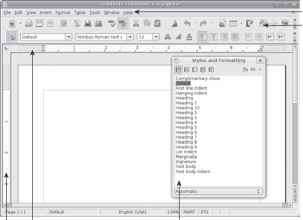
You can start Writer from the command line by executing the oowriter command. More conveniently, a menu item for Writer is installed in the Applications C Office menu called OpenOffice.org Word Processor. To start Writer from the menus, select this menu item. The application starts, displaying an empty document, as shown in Figure 16-8. Starting Writer Starting Writer Writer provides excellent online help, as do all of the tools in the OpenOffice.org suite, so I won't bore you by walking you through each menu and entry that it contains. However, as a quick overview of the Writer interface, the callouts in Figure 16-8 highlight the following areas Menus The drop-down menus in Writer are organized much like the menus in Microsoft Word to provide a familiar user experience. Menu items with an arrow at their right edge lead to other, related submenus.
Word Processing Open Officeorg Writer
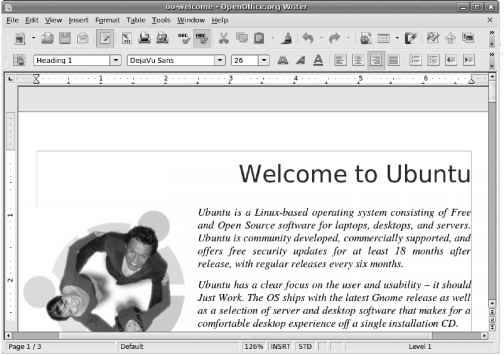
OpenOffice.org Writer (Applications Office OpenOffice.org Word Processor), shown in Figure 11-1, is the word processor component. As with Microsoft Word, it's fully WYSIWYG (What You See Is What You Get), so you can quickly format text and paragraphs. This means the program can be used for elementary desktop publishing, and pictures can be easily inserted (using the Insert menu). Figure 11-1. OpenOjfice.org Writer Figure 11-1. OpenOjfice.org Writer Writer's toolbars provide quick access to the formatting tools, as well as to other common functions. The vast majority of menu options match those found in Word. Right-clicking the text itself also offers quick access to text-formatting tools. As with all OpenOffice.org packages, Writer is fully compatible with Microsoft Office files, so you can save and open .doc files. Just click File Save As, and click the arrow alongside File Type to choose a document format. The only exception is password-protected Word files, which cannot be opened.
Drawing with Open Officeorg Draw
Draw is a separate drawing program in the OpenOffice.org office application suite, but you can also access many of Draw's drawing tools from other OpenOffice.org applications, such as Writer and Impress. When you use Draw to prepare drawings, you save the drawing in a file. You can later insert the drawing as a Draw object into other OpenOffice.org documents, such as a Writer document or an Impress presentation. The nice part about inserting a Draw object into a Writer or Impress document is that you can always doubleclick and edit the drawing directly, even while it's in the Writer or Impress document.
Taking a Quick Scribus Tutorial
Like OpenOffice.org Writer and most other publishing-related applications, Scribus comes complete with a few templates to get you started. When you first use a new application, it's often easiest to start with someone else's document, and then modify it to suit your purposes. Once you get the hang of using the application, you can create your own documents, as explained in the next section. This section provides a whirlwind tour of the key features of Scribus to get you comfortable with the basics.
Taking a tour of Open Officeorg Draw
Along the left side of the window is the main toolbar, which you can remove at any time by choosing ViewOToolbarsOMain Toolbar. Each icon in this series represents a different functionality. If a button is extensible (has a little arrow on it), you can click on it to open a dialog box with the options contained within. Each icon is described in Table 17-7. As you can see, this main toolbar is more similar to that in OpenOffice.org Impress than to the one in OpenOffice.org Writer.
Network Device initialization
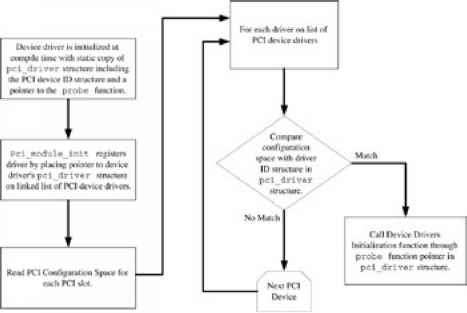
Linux provides some generic device allocation and initialization functions for the convenience of writers of network interface drivers. Most of these are found in linux net net_init. c, except for some functions that are specific for Ethernet devices. For example, we will look at the initialization sequence for an Ethernet network interface device, shown in Figure 4.1. This sequence uses an allocation method provided for Ethernet drivers. The function alloc_etherdev defined in drivers net net_init. c and declared in file linux include linux etherdevice.h, does both structure allocation and name string initialization. Under the covers, alloc_etherdev calls alloc_netdev and passes it a pointer to a setup function as the second argument. This function used to be ether_setup in earlier kernel versions. At this point, the function netdev_boot_setup, actually saves any boot time settings in an instance of the netdev_boot_setup structure.
Creating and Destroying a Pipe
Initializes the start, len, waiting readers, and waiting writers fields of the pipe_inode_info structure to 0. 2. Sets the readers and writers fields of the pipe_inode_info structure to 1. The process that issues a pipe( ) system call is initially the only process that can access the new pipe, both for reading and writing. To represent that the pipe has both a reader and a writer, the readers and writers fields of the pipe_inode_info data structure are initialized to 1. In general, each of these two fields is set to 1 only if the corresponding pipe's file object is still opened by a process the field is set to 0 if the corresponding file object has been released, since it is no longer accessed by any process. Forking a new process does not increase the value of the readers and writers fields, so
Read Accepts User Input
The first line of the readl script uses echo to prompt you to enter a line of text. The -n option suppresses the following NEWLINE, allowing you to enter a line of text on the same line as the prompt. The second line reads the text into the variable firstline. The third line verifies the action of read by displaying the value of firstline. The variable is quoted (along with the text string) in this example because you, as the script writer, cannot anticipate which characters the user might enter in response to the prompt. Consider what would happen if the variable were not quoted and the user entered * in response to the prompt



Using sudo to Grant Root Privileges

The user can also be a group so, for example, to grant permission to the Writers group to run YaST Online Update, add this line writers ALL sbin yast2 To grant the Writers group this same permission without having to enter a password, add this line writers ALL sbin yast2 NOPASSWD ALL Once configured, sudo is very easy to use. Anyone in the Writers group should now be able to type this command to run YaST Depending on how you set it, writers may be prompted for their own user password to confirm that they are the person that is logged in.
Working with Calc Files
Just like the Writer package, the Calc package allows you to read and write various spreadsheet formats Just like with Writer, the advantage to using Calc is its versatility. You can work with just about all of the popular spreadsheet types, as well as save your spreadsheets as those types.
File such as block and character device files FIFOs and even regular files it cannot create directories or sockets
If the access mode is either write-only or read write, it adds one to the writers and w_counter fields of the pipe_inode_info structure. Moreover, if the access mode is write-only and there is no other writing process, it wakes up any reading process sleeping in the wait queue. 6. If there are no readers or no writers, it decides whether the function should block or terminate returning an error code (see Table 19-5). Read-only, with writers Read-only, no writer Wait for a writer
Sample Implementation scullpipe
Within a driver, a process blocked in a read call is awakened when data arrives usually the hardware issues an interrupt to signal such an event, and the driver awakens waiting processes as part of handling the interrupt. The scull driver works differently, so that it can be run without requiring any particular hardware or an interrupt handler. We chose to use another process to generate the data and wake the reading process similarly, reading processes are used to wake sleeping writer processes. The resulting implementation is similar to that of a FIFO (or named pipe) filesystem node, whence the name. * finally, awaken any writers and return * wake_up_interruptible(&dev-; outq) Note also, once again, the use of semaphores to protect critical regions of the code. The scull code has to be careful to avoid going to sleep when it holds a semaphore otherwise, writers would never be able to add data, and the whole thing would deadlock.
Summarizing the KDE Project
As you read sections of the KDE Web site or documentation, you'll find strange spellings and sentences. Many writers for KDE are not native English speakers, but they produce a great deal of KDE material in their free time. I try to put away my red pencil and appreciate the work they've done.
Access to User Space in Linux
Memory access was handled differently in the 2.0 kernels. The Linux virtual memory system was less well developed at that time, and memory access was handled a little differently. The new system was the key change that opened 2.1 development, and it brought significant improvements in performance unfortunately, it was accompanied by yet another set of compatibility headaches for driver writers. Life would be relatively easy for the compatibility-conscious driver writer if it weren't for the fact that put_user and get_user are implemented as macros in all Linux versions, and their interfaces changed. As a result, a straightforward fix using macros cannot be done.
The HAL Daemon and haldevicemanager halgnome
When you run the manager, it will display an expandable tree of your devices arranged by category, in the left panel. The right panel will display information about the selected device. A Device pane will list the basic device information such as the vendor and the bus type. The Advanced pane will list the HAL device properties defined for this device, as described in later sections, as well as sys file system paths for this device. For device controllers there will also be a USB or PCI panel. For example, a DVD writer could have an entry for the storage.cdrom.cdr property that says it can write CD-R discs. For an IDE CD DVD-ROM device you may find this under IDE (some third party IDE controllers may be labeled as SCSI devices). A typical entry would look like this. The bool is the type of entry, namely boolean
CD Burning and Ripping Utilities
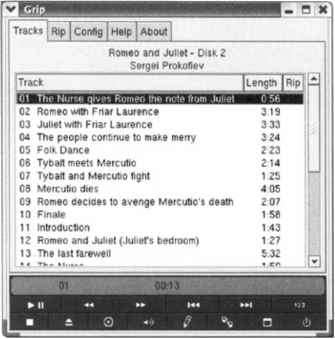
The cdrecord utility is a command line utility for recording files onto writable CDs using an appropriate CD-Writer drive (CD-R or CD RW). It is installed by default in Red Hat Linux 9, and its web site can be found at . If you find all this command line stuff too daunting, you could use the GnomeToaster application. GnomeToaster is a graphical CD recording utility written for the GNOME environment. You can start this application by selecting Main Menu System Tools More System Tools CD Writer, or by typing gtoaster at the command line
Disks Partitions and Mount Points
The bottom line of any computer system is storing, retrieving, manipulating, and saving information. As a writer and computer systems administrator, I'm always amazed when friends who are generally computer savvy say to me, Your laptop is so slow. Why don't you upgrade Frankly, if I could type faster than my primary laptop's 1.4 GHz Pentium processor could handle, I'd be posing for Ripley's Believe It or Not ads or touring with the circus instead of writing books. On the other hand, if it took five minutes for me to save a chapter of whatever I'm working on or if I could never find the space to save a modified file without deleting something else, I'd drop-kick my current laptop into the river in a heartbeat and buy the newest, brightest, shiniest Linux-capable laptop available today. For what I do, being able to reliably and quickly read and write data is far more important than blazing CPU speed.
Creating and Editing Formulae
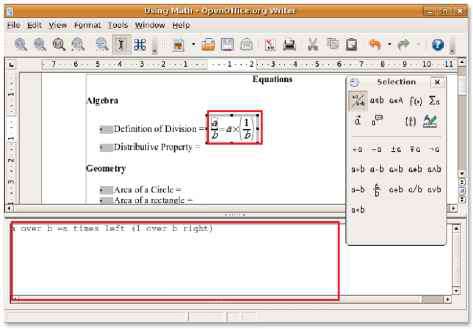
Though Math can be used with all the OpenOffice.org applications, it is primarily used as an equation editor with text documents. To be able to use Math when working with Writer perform the following steps 2. This invokes Math from inside the Writer window. Notice that the equation editor appears at the bottom of the document window. You can now access all the Math tools from inside the Writer window. A placeholder box appears besides the text where the equation is to be entered.
What are all the device files
Dev cdrom - a symbolic link to the appropriate drive interface. typically dev hdc or dev hdb (a CDROM) or dev scd0 (a CD-R RW writer). dev sr0 - the first scsi CD drive (sometimes called dev scd0). If you have an ATAPI CD writer. it will also be likely here. dev sr1-is the second scsi CD drive (sometimes called dev scd1). ( dev sr2 is the third scsi CD drive. etc. There can be many CD-writer device (but my RedHat have dev cdrecorder)
Inserting Objects with Object Linking and Embedding
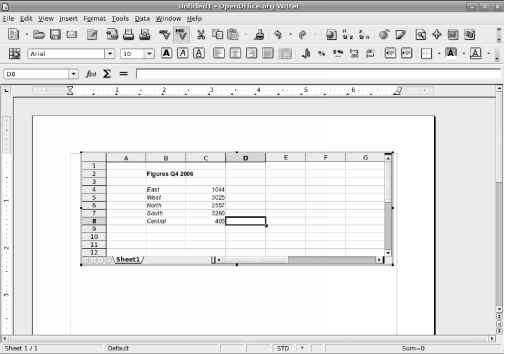
All the OpenOffice.org programs are able to make use of Object Linking and Embedding (OLE). This effectively means that one OpenOffice.org document can be inserted into another. For example, you might choose to insert a Calc spreadsheet into a Writer document. The main benefit of using OLE over simply copying and pasting the data is that the OLE item (referred to as an object) will be updated whenever the original document is revised. In this way, you can prepare a report featuring a spreadsheet full of figures, for example, and not need to worry about updating the report when the figures change. Figure 22-4 shows an example of a spreadsheet from Calc inserted into a Writer document.
Communication Between Parent and Child Processes
Void writer (const char* message, int count, FILE* stream) to it. * stream fdopen (fds 1 , w ) writer ( Hello, world. , 5, stream) close (fds 1 ) Note that after writing in the writer function, the parent flushes the pipe by calling fflush. Otherwise, the string may not be sent through the pipe immediately.
The Linux Source Tree
We have already discussed the contents of the configs subdirectory, so let us examine the other directories found under usr src iinux-2.6. The most useful for us is the Documentation directory. In it and its subdirectories, you will find almost all the documentation concerning every part of the kernel. The file 00-index (each Documentation subdirectory also contains a 00-index file as well) contains a list of the files in the main directory and a brief explanation of what they are. Many files are written solely for kernel programmers and application writers, but a few are useful to the intermediate or advanced Linux user when attempting to learn about kernel and device driver issues. Some of the more interesting and useful documents are
Iomega drives Zip Jaz and so on
Detected scsi removable disk sda at scsi0, channel 0, id 5, lun 0 scsi detected 1 SCSI cdrom 1 SCSI disk total. sr0 scsi3-mmc drive 16x 16x writer cd rw xa form2 cdda tray SCSI device sda hdwr sector 512 bytes. Sectors 2091050 1021 MB 1.0 GB sda Write Protect is off Partition check sda sdal hda hda1 hda2
Preparing presentations
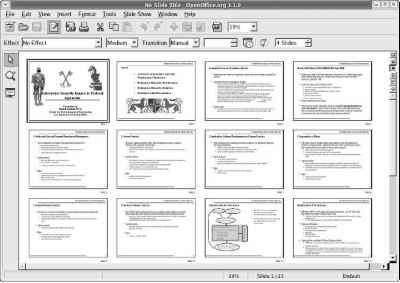
If you're going to present information that's already in a Writer document (see Chapter 1 of this minibook), you can use the outline of that Writer document to start a presentation. The Writer document does have to follow one rule it must use the heading styles (Heading 1, Heading 2, and so on) for the major sections in the document. To create a presentation from the outline of a Writer document that uses the heading styles, open the document in Writer and choose SendOOutline to Presentation from the Writer menu. An Impress window opens with a new presentation with slides based on the headings in the Writer document. Each Heading 1 style becomes a new slide and the Heading 2 and Heading 3 styles appear as bulleted text in the slides.
Controlling LaTeX Paragraphs Line Breaks and Pages
In LaTeX, paragraph formatting (indentation, skipping space between paragraphs, and so on) is handled automatically. The only task left to the writer is to indicate when a new paragraph should begin. You do this by inserting a blank line in the LaTeX source file using your text editor's Enter key. Sometimes it is the writer's intent to insert a line break. You can think of a line break as being like pressing the Enter key in the middle of a paragraph in a plain text file the cursor moves to a new line without beginning a new paragraph, indenting, or leaving empty vertical spaces after the previous line.
Installing Git on Windows
Git is an open source, free, distributed, version control system created by Linus Torvalds the creator of Linux. A version control system tracks changes in the files and folders of your project over time, and allows you to recover back versions. It can be used on a large variety of projects by software developers and writers, for example. It was built to be a distributed, and allow developers working around the globe to collaborate, and at the same time work independently of one another.
Git in Windows - Getting Started with the Git GUI
I'll leave you to explore some of the other menu choices in these Gui's. Git is used by any one that builds projects, like software developers and writers, to keep track of changes in their files. There are currently three very good books on Git if you'd like to get really proficient.
Creating bootable CD-ROMS Part 2 - bootcd
The most likely problem you will encounter is that your currently running system won't fit upon a single CD-ROM. This isn't really an avoidable problem at the moment unless your base system is a minimalist installation - although it might be something which is solvable in the future when DVD writer support arrives.
Simple CD-ROM & ISO image cookbook.
If you've created an ISO image you can burn it to your CD-writer using the cdrecord program. Install it with Usage is really beyond the scope of this introduction, but in brief you'd first proceed by finding the CD-Writer device upon your system Here we have a device labelled 1,0,0 . To write an image to that writer we run
Burning DVDs on Debian for Newbies
DVD writers have become so common these days that there is hardly any difference between the price of a CD-writer drive and a DVD-writer drive. So I'm assuming that almost everyone would be buying a DVD writer drive these days. Below are a few tips for newbies on how to burn DVDs on a Debian box using the command line. Other GUI tools like k3b, nautilus burner, etc exists but its always fun to know how to do that stuff from command line. You can also add the option -dvd-compat when writing a DVD for DVD-ROM Video players to get maximum compatibility. Other helpful options are -V 'volid' which gives the volume ID for the disk and -speed N if you want to use a particular speed. Remember to change dev dvd above to your DVD writer device name according to your system.
Tip Which Image
Insert a blank CD into your CD writer. 1. Insert a blank CD into your CD writer. 1. Insert a blank CD into your CD writer. 3. In the dialog box, choose your CD writer and speed, and then click on Write. The Writing Files to Disk Progress dialog box opens, and Nautilus begins writing the disk.
Mkswap
On your desktop, DVD CD recording is now handled directly by the Gnome Nautilus CD DVD Creator tool. As described in Chapter 3, you simply insert a blank DVD CD disk, double-click to open it with the CD DVD Creator, and drag the files you want to copy to the disk window. Then click the Write button. Alternatively you could use CD DVD writers like K3b. To manually record data to DVD CD-ROM discs from the command line is more complicated. The process involves creating a CD image file of the CD-ROM, and then writing that image file to a CD-R or CD-RW disc in your CD-R RW drive. With the mkisofs command, you can create a CD image file, which you can then write to a CD-R RW write device. Once you create your CD image file, you can write it to a CD-write device, using the cdrecord or cdwrite application. The cdrecord application is a more powerful application with many options.
Registering Drivers
USB (Universal Serial Bus) was developed at the end of the '90s of what is now the last century as an external bus to satisfy ever-more-demanding PC requirements and to produce solutions for new computer types such as handhelds, PDAs, and the like. As a universal external bus, USB delivers its benefits when used in conjunction with devices requiring low to medium data transfer rates such as mice, Webcams, and keyboards. However, more broadband-intensive devices such as external hard disks, CD-ROMs, and CD writers can also be operated on USB buses. The maximum transfer rate for USB 1.1 is limited to 12 MBit second but Version 2.0 of the standard supports higher rates of up to 480 MBit second.
HTML Authoring Tools
You can write HTML documents in many ways you can use an ASCII editor, a word processor, or a dedicated HTML tool. The choice of which you use depends on personal preference and your confidence in HTML coding, as well as which tools you can obtain easily. Because many HTML-specific tools have checking routines or filters to verify that your documents are correctly laid out and formatted, they can be appealing. They also tend to be more friendly than non-HTML editors. On the other hand, if you are a veteran programmer or writer, you may want to stick with your favorite editor and use a filter or syntax checker afterwards. CU_HTML is a template for Microsoft's Word for Windows that gives a almost WYSIWYG view of HTML documents. CU_HTML is a template, meaning that it adds its own DLLs to Word to enhance the system. Graphically, it looks much the same as Word, but with a new toolbar and pull-down menu item. CU_HTML provides a number of different styles and a toolbar of often-used tasks.
The Big Reader Lock
Read write spin locks are useful for data structures that are accessed by many readers and a few writers. They are more convenient than normal spin locks because they allow several readers to concurrently access the protected data structure. However, any time a CPU acquires a read write spin lock, the counter in rwlock_t must be updated. A further access to the rwlock_t data structure performed by another CPU incurs in a significant performance penalty because the hardware caches of the two processors must be synchronized. Even worse, the new CPU changes the rwlock_t data structure, so the cache A special type of read write spin locks, named big reader read write spin locks, was designed to address this problem. The idea is to split the reader portion of the lock across all CPUs, so that each per-CPU data structure lies in its own line of the hardware caches. Readers do not need to stomp one another, so no reader CPU snoops the reader lock of another CPU.
Read Write Semaphores
Many kernel control paths may concurrently acquire a read write semaphore for reading however, any writer kernel control path must have exclusive access to the protected resource. Therefore, the semaphore can be acquired for writing only if no other kernel control path is holding it for either read or write access. Read write semaphores improve the amount of concurrency inside the kernel and improve overall system performance. The kernel handles all processes waiting for a read write semaphore in strict FIFO order. Each reader or writer that finds the semaphore closed is inserted in the last position of a semaphore's wait queue list. When the semaphore is released, the processes in the first positions of the wait queue list is checked. The first process is always awoken. If it is a writer, the other processes in the wait queue continue to sleep. If it is a reader, any other reader following the first process is also woken up and gets the lock.
Symbolic Links
Certain device files are really symbolic links bearing common device names that are often linked to the actual device file used. A symbolic link is another name for a file that is used like a shortcut, referencing that file. Common devices such as printers, CD-ROM drives, hard drives, SCSI devices, and sound devices, along with many others, will have corresponding symbolic links. For example, a dev cdrom symbolic link links to the actual device file used for your CD-ROM. If your CD-ROM is an IDE device, it may use the device file hdc. In this case, dev cdrom is a link to dev hdc. In effect, dev cdrom is another name for dev hdc. Serial ATA DVD CD drives will be linked to scd devices, such as scd0 for the first Serial ATA CD DVD drive. If your drive functions both as a CD and DVD writer and reader, several links will exist to the same device. In this case the links cdrom, cdrw, cdwriter, dvd, dvdrw, and dvdwriter will all link to the same CD DVD RW-ROM device.
Poll and select
The poll_table structure, the second argument to the poll method, is used within the kernel to implement the poll and select calls it is declared in , which must be included by the driver source. Driver writers need know nothing about its internals and must use it as an opaque object it is passed to the driver method so that every event queue that could wake up the process and change the status of the poll operation can be added to the poll_table structure by calling the functionpoll_wait With real FIFOs, for example, the reader sees an end-of-file when all the writers close the file, whereas in scullpipe the reader never sees end-of-file. The behavior is different because a FIFO is intended to be a communication channel between two processes, while scullpipe is a trashcan where everyone can put data as long as there's at least one reader. Moreover, it makes no sense to reimplement what is already available in the kernel.
Popen and pclose
Create a FIFO programmatically using the mkfifo function. The first argument is the path at which to create the FIFO the second parameter specifies the pipe's owner, group, and world permissions, as discussed in Chapter 10, Security, Section 10.3, File System Permissions. Because a pipe must have a reader and a writer, the permissions must include both read and write permissions. If the pipe cannot be created (for instance, if a file with that name already exists), mkfifo returns 1. Include and if you call mkfifo. A FIFO can have multiple readers or multiple writers. Bytes from each writer are written atomically up to a maximum size of PIPE_BUF (4KB on Linux). Chunks from simultaneous writers can be interleaved. Similar rules apply to simultaneous reads. Pipes in the Win32 operating systems are very similar to Linux pipes. (Refer to the Win32 library documentation for technical details about these.
Mail Merging
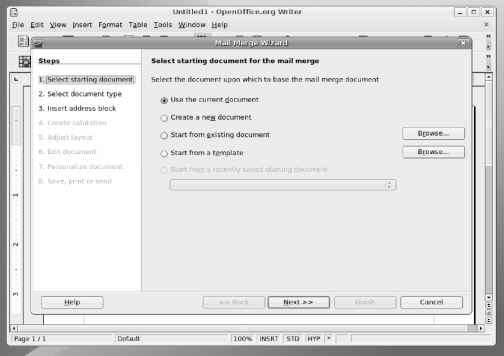
OpenOffice.org makes the procedure very easy, but it requires source data that will be merged into the document. As with Microsoft Word, you can either enter this data within Writer itself or choose to import data from a separate document. Unless you have enough knowledge of databases to connect one to OpenOffice.org (the program works with dBase and MySQL files, among others), you may want to input existing data in the form of a comma-separated value (CSV) text file. This is the simplest form of data file that is understood by the majority of office programs and databases. Here, we're going to look at entering the data within Writer, which is the best policy for smaller mail merge operations. You can then output the data as a CSV file, so you can use it again later. Here are the steps for using mail merge (click the Next button after each step) 4. You're asked to tell Writer about your data. Writer needs to know where to find the addresses that will be merged into the document.
Want to Do That
It was 1985, and I was in a chartered bus in New York City, heading for a press reception with a bunch of other restless media egomaniacs. I was only beginning my media career (as Technical Editor for PC Tech Journal) and my first book was still months in the future. I happened to be sitting next to an established programming writer guru, with whom I was impressed and to whom I was babbling about one thing or another. I won't name him, as he's done a lot for the field, and may do a fair bit more if he doesn't kill himself smoking first. Further discussion got me nowhere in a Pascal direction. But some probing led me to understand that you couldn't write Windows apps in Turbo Pascal. It was impossible. Or the programming writer guru didn't know how. Maybe both. I never learned the truth. But I did learn the meaning of the Infamous Question.
Adding Desktop Icons
The easiest way to do this is with the OpenOffice.org application. In OpenOffice. org you can open a blank Writer document, then save it as an ODF text document template file (with the extension .ott) in the Templates folder. Make sure you name the file using a descriptive name, because that's what appears in the Create a Document menu. When you select the template from the Create a Document menu, Ubuntu creates a new file using the template file.
Inserting Pictures
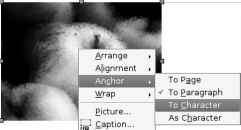
Writer includes quite substantial desktop publishing-like functions, such as the ability to insert pictures into text documents and to have text flow around pictures. Tip If you have a scanner, you can also scan pictures directly into Writer documents. Simply click Insert Picture Scan Select Source. Graphics that are imported into Writer must be anchored in some way. In other words, they must be linked to a page element so that they don't move unexpectedly. By default, they're anchored to the nearest paragraph, which means that if that paragraph moves, the graphic will move, too. Alternatively, by right-clicking the graphic, you can choose to anchor it to the page, paragraph, or character it is on or next to, as shown in Figure 23-4. Selecting to anchor it to the page will fix it firmly in place, regardless of what happens to the contents of the surrounding text. The As Character option is slightly different from the To Character option.
Seq Locks
Seq locks are useful to provide a very lightweight and scalable lock for use with many readers and a few writers. Seq locks, however, favor writers over readers. The write lock always succeeds in being obtained so long as there are no other writers. Readers do not affect the write lock, as is the case with reader-writer spin locks and semaphores. Furthermore, pending writers continually cause the read loop (the previous example) to repeat, until there are no longer any writers holding the lock.
Using Open Office
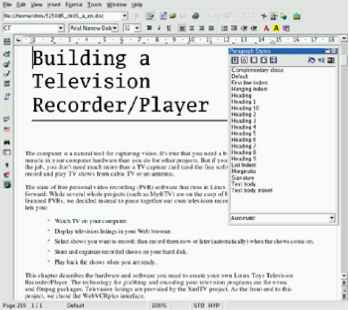
Red Hat Linux includes the entire OpenOffice suite of desktop applications. Based on source code from Sun Microsystem's StarOffice, OpenOffice consists of the following office-productivity applications OpenOffice Writer A word-processing application that can work with documents in file formats from Microsoft Word, StarOffice, and several others. Writer also has a full set of features for using templates, working with fonts, navigating your documents, including images and effects, and doing tables of contents. OpenOffice Calc A spreadsheet application that lets you incorporate data from Microsoft Excel, StarOffice, Dbase, and several other spreadsheet formats. Some nice features in Calc let you create charts, set up database ranges (to easily sort data in an area of a spreadsheet), and use data pilot to arrange data in different points of view.
Printing Envelopes
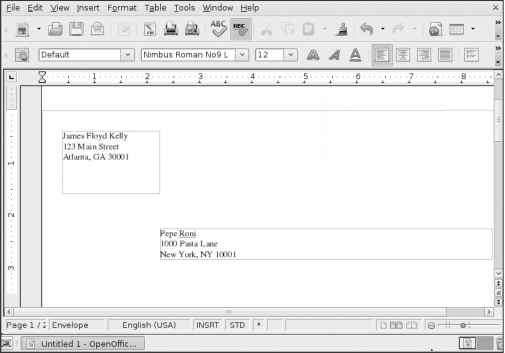
One nice feature that Writer supports is the ability to print envelopes if your printer supports this function. To print an envelope, first load your printer with a blank envelope consult your printer's documentation for proper orientation and insertion of an envelope. Next, open a new Writer document, click the Insert menu, and choose the Envelope option. A window opens, in which you can type your address in the Sender box and the recipient's address in the Addressee box (see Figure 5-16). Note The Format tab (refer to Figure 5-16) enables you to tweak the placement of the addresses, moving them in or out as well as up and down. Use this option if you don't like Writer's default location for printing the addresses. Imagine for a moment that you have a list of 30 people to whom you want to send an important letter.
More Products
| Get Paid To Write Online |